
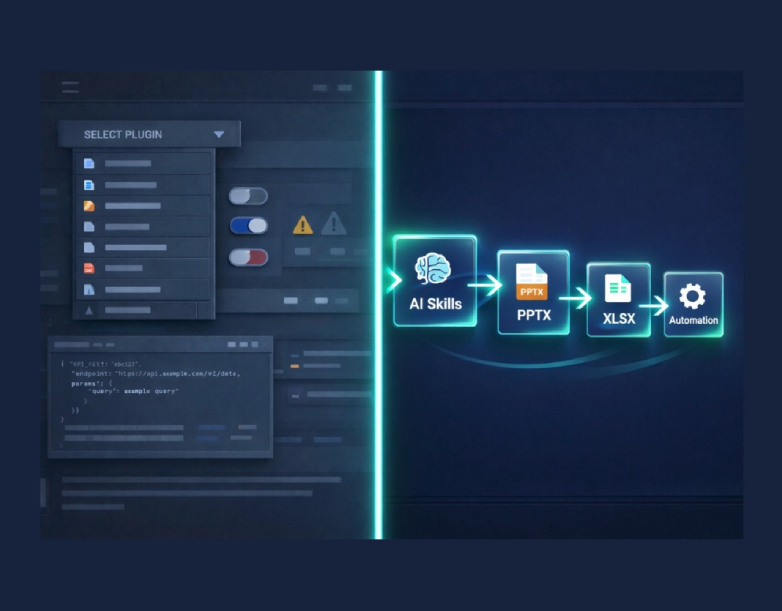
The way we extend and customise AI assistants is changing fast. If you’ve been following the AI space – or if you’re considering AI training for your organisation – you’ve likely heard terms like “plugins,” “skills,” “MCP,” and “custom GPTs” thrown around.
But what do they actually mean? And more importantly, which approach delivers real results for your business?
This guide breaks down the key differences between Claude Skills and the plugin model, explains why it matters for organisations adopting AI, and helps you understand what to look for in HRD Corp claimable AI training programmes that teach practical, current knowledge.
The Rise and Fall of AI Plugins
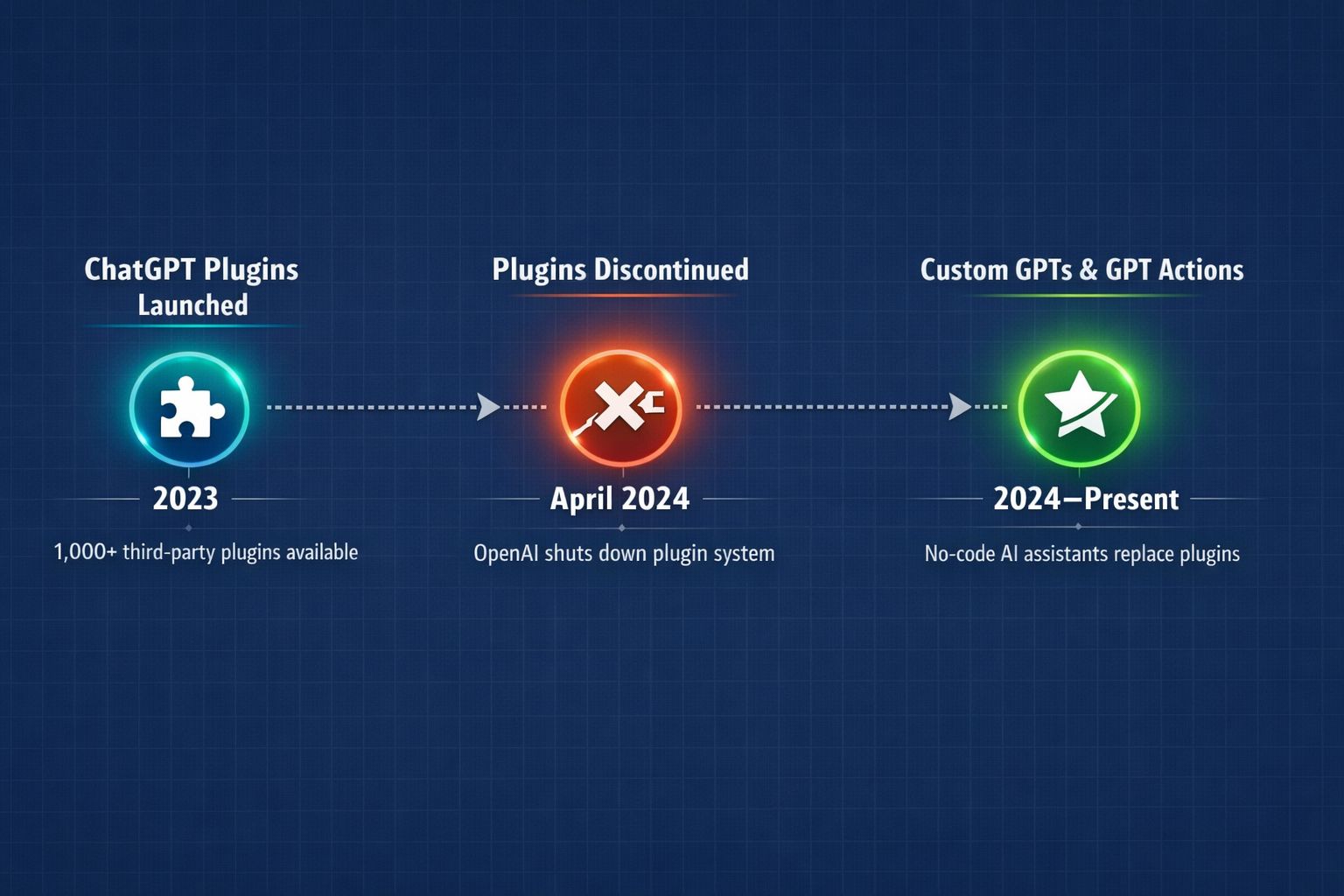
ChatGPT Plugins were one of the first major attempts to let an AI assistant connect with external tools and services. Launched by OpenAI in 2023, plugins allowed ChatGPT to browse the web, analyse PDFs, query databases, and interact with third-party apps like Zapier, Expedia, and Wolfram Alpha.
It sounded revolutionary. In practice, the plugin model had serious limitations.
Plugins required third-party developers to build and maintain each integration. Users had to manually select which plugins to activate for each conversation. Quality varied wildly across the plugin marketplace, and most ChatGPT users never explored the feature. Despite having over 1,000 plugins available, usage remained concentrated among power users. The complexity created friction rather than solving problems.
By April 2024, OpenAI officially discontinued the plugin system entirely. They replaced it with Custom GPTs and GPT Actions – a more flexible approach where anyone could create a specialised AI assistant without coding, and connect it to external services through API actions.
The plugin era lasted barely a year. But the lessons it taught the industry were invaluable.
Enter Claude Skills: A Fundamentally Different Approach
When Anthropic introduced Claude Skills in October 2025, they took a completely different path from the plugin model.
Rather than requiring developers to build external integrations, Skills are folders containing instructions, scripts, and resources that Claude can load on demand. Think of them as knowledge packages – they teach Claude how to perform specific tasks in a repeatable, consistent way.
Here’s what makes Skills different:
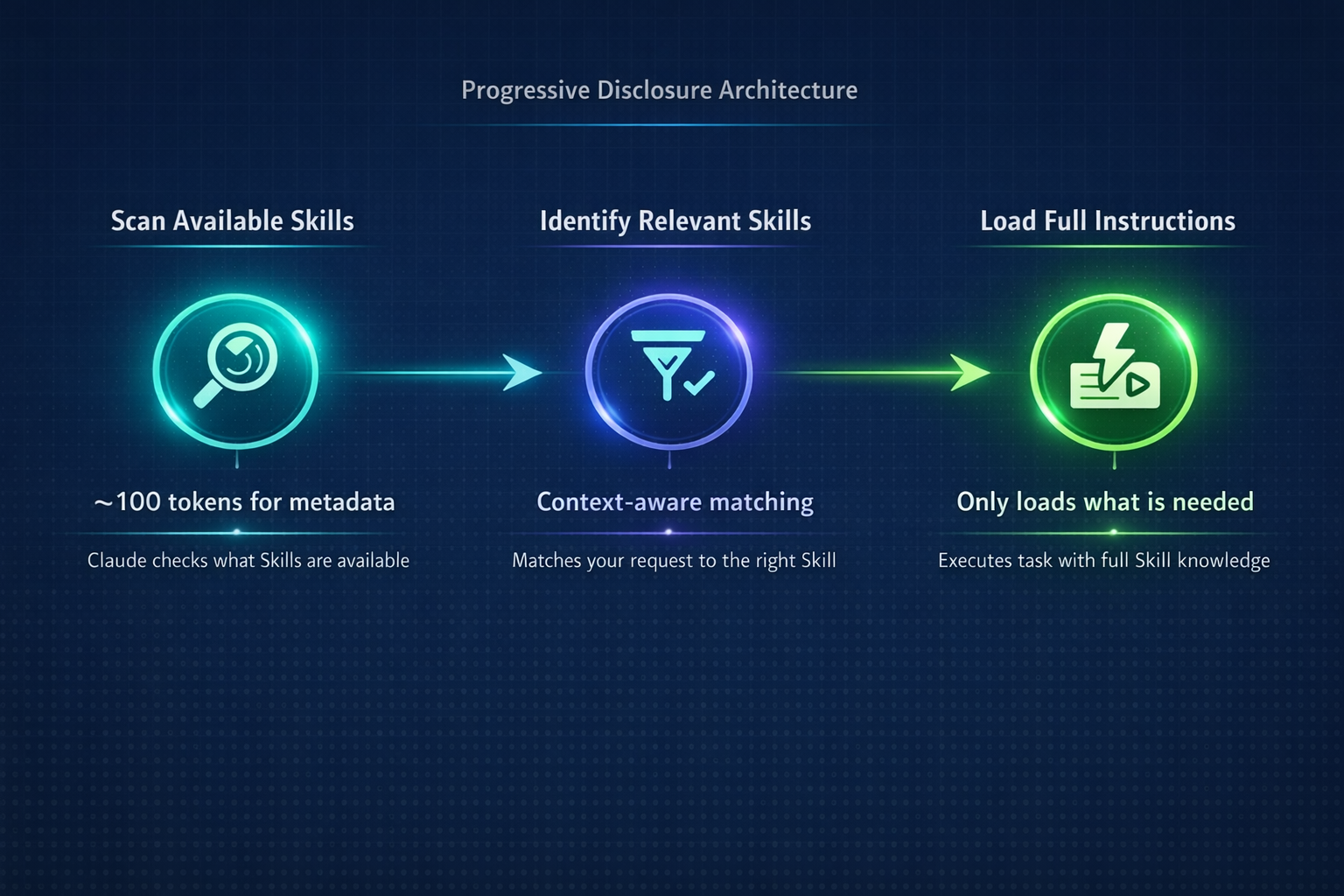
Claude doesn’t load everything at once. It scans available Skills (costing roughly 100 tokens for metadata), identifies which ones are relevant to your task, and only then loads the full instructions. You can have dozens of Skills available without overwhelming the system.
Skills are built on Markdown files with optional scripts – not complex API schemas or external servers. A subject matter expert can create a useful Skill without being a software developer. This dramatically lowers the barrier to entry for organisations wanting to customise AI for their workflows.
Unlike plugins that required manual selection, Claude automatically identifies and loads relevant Skills based on your request. Ask it to create a PowerPoint presentation and it invokes the PPTX skill on its own. Ask it to generate an Excel report and the XLSX skill activates. No toggling, no configuration.
Skills can execute code in a secure environment, enabling deterministic actions like file creation, data parsing, and analytics – not just text generation.
Multiple Skills can work together in the same task. Unlike plugins where you typically ran one at a time, Skills are designed to stack and complement each other – creating compounding capability over time.
Skills vs Plugins: A Direct Comparison
| Aspect | ChatGPT Plugins (Discontinued) | Claude Skills |
|---|---|---|
| Status | Discontinued April 2024 | Active and expanding |
| Who builds them | Third-party developers required | Anyone – Markdown-based |
| Activation | Manual selection per conversation | Automatic, context-aware |
| Technical complexity | High – API schemas, server hosting | Low – Markdown + optional scripts |
| Ecosystem | Closed, vendor-controlled marketplace | Open, shareable, forkable |
| Code execution | Limited to Code Interpreter | Full sandbox environment |
| Composability | One plugin at a time (typically) | Multiple Skills work together |
| Transparency | Black box | Open – read, modify, and share |
Where MCP Fits In
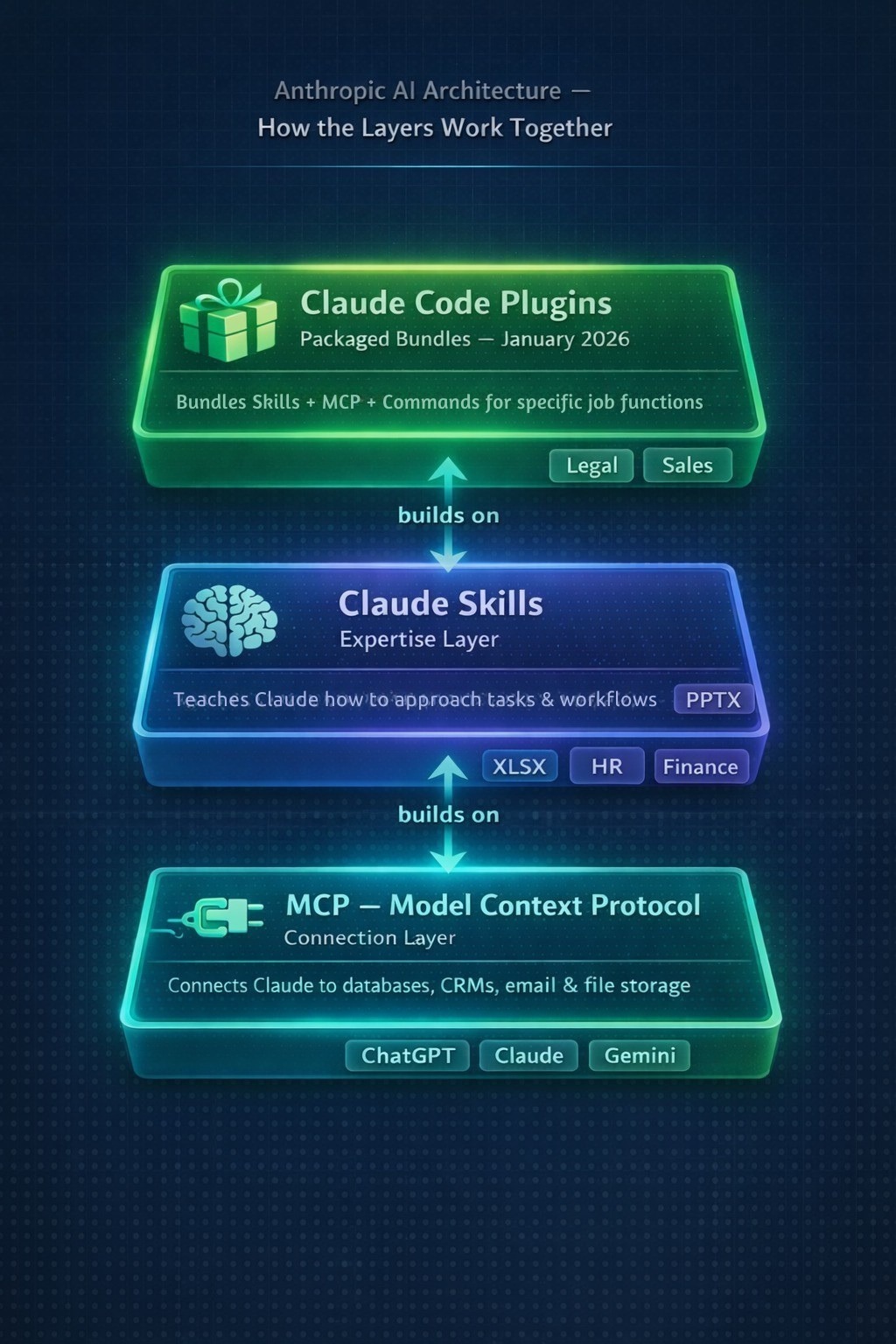
You might also hear about MCP – the Model Context Protocol – which Anthropic introduced in November 2024 and later donated to the Linux Foundation. MCP is different from both plugins and Skills, and understanding the distinction matters for how you think about AI investment.
MCP is the plumbing. It provides a standardised way for AI models to connect with external systems – databases, CRMs, email, file storage, and so on. Think of it as a universal connector that now works across Claude, ChatGPT, Gemini, and other major AI platforms. OpenAI adopted MCP in March 2025, followed by Google DeepMind in April 2025, making it the industry standard for AI-to-system connections.
Skills are the expertise. They teach the AI how to approach specific tasks, what best practices to follow, and what workflows to use.
In Anthropic’s evolving architecture, these layers work together. MCP connects Claude to your systems. Skills give Claude the knowledge to work effectively with those systems. And the newest addition – Claude Code Plugins (introduced January 2026) – bundles Skills, MCP connectors, and commands into installable packages for specific job functions like legal review, sales prospecting, and financial reporting.
Why This Matters for Malaysian Businesses

If your organisation is evaluating AI training programmes – especially HRD Corp claimable ones – the Skills vs Plugin distinction isn’t just academic. It directly affects what your team can actually do after the training.
- Training that teaches the old plugin model is already outdated. Plugins were discontinued nearly two years ago. Any programme still centred on “how to use ChatGPT plugins” is teaching tools that no longer exist.
- Skills represent the current and future state of AI customisation. Understanding how to create and use Skills means your team can build reusable AI workflows tailored to your specific business processes – from HR onboarding automation to financial reporting to marketing content creation.
- The barrier to entry has dropped dramatically. With Skills, you don’t need a team of developers to customise AI for your organisation. A well-trained HR manager, marketing executive, or operations lead can create Skills that standardise how AI handles their department’s tasks.
- Composability changes the game. Because multiple Skills work together, your organisation can build a library of AI capabilities over time. Each new Skill adds to what your team can accomplish, creating compounding returns on your training investment.
- For Malaysian businesses specifically: The combination of lower entry costs and HRD Corp grant support means that now is an unusually good time to invest in building real AI capability – before competitors do.
What to Look for in HRD Corp Claimable AI Training Programmes
When evaluating AI training for your organisation, here are the questions worth asking before you commit:
- Does the programme teach current tools? The AI landscape moves fast. Programmes should cover Skills, MCP, and the latest AI capabilities – not discontinued features like plugins.
- Is there hands-on practice? Understanding AI extensibility concepts is important, but your team needs to actually build something during the training. Creating a Skill, setting up an automation workflow, and seeing real output is what creates lasting capability.
- Does it cover practical business applications? The best programmes connect AI capabilities directly to business outcomes – automating reporting, streamlining HR processes, accelerating content creation, improving customer communication.
- Is the trainer actively practising what they teach? AI tools evolve monthly. Trainers who are actively building with these tools daily will teach current, practical knowledge rather than theoretical concepts from six months ago.
- Can the training be customised to your industry? Generic AI training has limited ROI. Programmes tailored to your specific industry and business challenges deliver far more value.
- Is the provider HRD Corp approved? Verify the provider’s approval status directly on the HRD Corp portal. Approved programmes allow your organisation to claim training costs under the SBL Scheme.
The Bottom Line
The evolution from plugins to Skills reflects a broader shift in how we think about AI customisation. We’ve moved from a model where extending AI required developers, external servers, and marketplace gatekeepers – to one where domain experts can package their knowledge into reusable, shareable, automatically-invoked capabilities.
For Malaysian businesses navigating the AI transformation, this shift is an opportunity. The organisations that invest in understanding and building with current AI capabilities – not yesterday’s discontinued features – will gain meaningful competitive advantage.
The question isn’t whether your team needs AI skills. It’s whether the training you invest in teaches the right ones.
Ready to Train Your Team on Current AI Tools?
Ommtech Digital Marketing Academy offers HRD Corp claimable AI training programmes covering Claude Skills, MCP, n8n automation, and practical AI implementation – tailored for Malaysian businesses.
Frequently Asked Questions
What are Claude Skills?
Claude Skills are reusable knowledge packages introduced by Anthropic in October 2025. They are folders containing instructions, scripts, and resources that Claude AI can load on demand to perform specific tasks. Unlike ChatGPT Plugins, Skills are markdown-based, automatically invoked, and can be created by anyone without developer expertise.
Are ChatGPT Plugins still available?
No. OpenAI officially discontinued ChatGPT Plugins on April 9, 2024. They were replaced by Custom GPTs and GPT Actions, which are available through the GPT Store. Custom GPTs offer more flexibility and can replicate all plugin functionality.
What is the difference between Claude Skills and ChatGPT Plugins?
The key differences are: Skills are markdown-based and can be created by non-developers, while plugins required third-party developer expertise. Skills are automatically invoked based on context, while plugins required manual selection. Skills are composable – multiple Skills work together seamlessly. And Skills are open and transparent – you can read, modify, and share them. ChatGPT Plugins have been discontinued since April 2024.
What is MCP and how does it relate to Claude Skills?
MCP (Model Context Protocol) is an open standard for connecting AI models to external systems like databases, CRMs, and email. MCP is the plumbing for external connections, while Skills provide domain expertise and workflow knowledge. They complement each other – MCP connects Claude to your systems, and Skills guide Claude in using those systems effectively.
Is there HRD Corp claimable AI training that covers Claude Skills in Malaysia?
Yes. HRD Corp approved training providers like Ommtech Digital Marketing Academy offer AI training programmes covering current tools including Claude Skills, MCP, AI automation, and practical AI implementation strategies tailored for Malaysian businesses. Look for programmes that teach current tools rather than discontinued features like ChatGPT Plugins.
Why should Malaysian businesses care about Claude Skills vs Plugins?
The shift from plugins to Skills reflects how AI customisation has become accessible to non-developers. Malaysian businesses investing in AI training should ensure their programmes teach current capabilities. Skills allow HR managers, marketing executives, and operations leads to create reusable AI workflows without developer support – meaning faster AI adoption and better ROI on training investment.
Can small Malaysian businesses benefit from Claude Skills?
Yes. Because Skills are markdown-based and require no developer expertise, even small businesses with limited IT resources can build custom AI workflows. A single well-trained staff member can create Skills that standardise how AI handles tasks like customer communication, report generation, or content creation.