
The AI Divide: What Malaysian Organisations Need to Know About Agentic AI in 2026

March 16, 2026

The AI Divide refers to the widening gap between organisations that have built genuine AI readiness — including the ability to work alongside autonomous AI agents — and those still relying on pre-AI workflows. It is already measurable in operational efficiency, talent retention, and market visibility.

1. The Divide Is Already Here

There is a question every HR and L&D leader in Malaysia will face in 2026 – not “should we adopt AI?” but “why are we falling behind organisations that already have?”

The AI Divide is not a future scenario. It is a present reality. And it is widening faster than most organisations realise.

Two quiet threats are already eroding competitiveness inside Malaysian organisations right now.

The Human USB Cable
Your best people spending half their day on tasks that a simple automation could finish in minutes. Talented, expensive employees doing work that should have been automated yesterday. Every hour they spend on manual data entry, report formatting, or repetitive coordination is an hour not spent on strategy, relationships, or decisions that actually require human judgment.
The Visibility Gap
Your customers are already using AI to find, evaluate, and shortlist vendors. If your business is not showing up in those AI-powered answers, your competitor is. The way buyers discover and select service providers has fundamentally changed, and organisations that have not adapted to this shift are invisible to a growing segment of their market.

Both threats share the same root cause: organisations are still operating on 2022 assumptions in a 2026 landscape.

2. Why This Is a Structural Shift, Not a Software Update
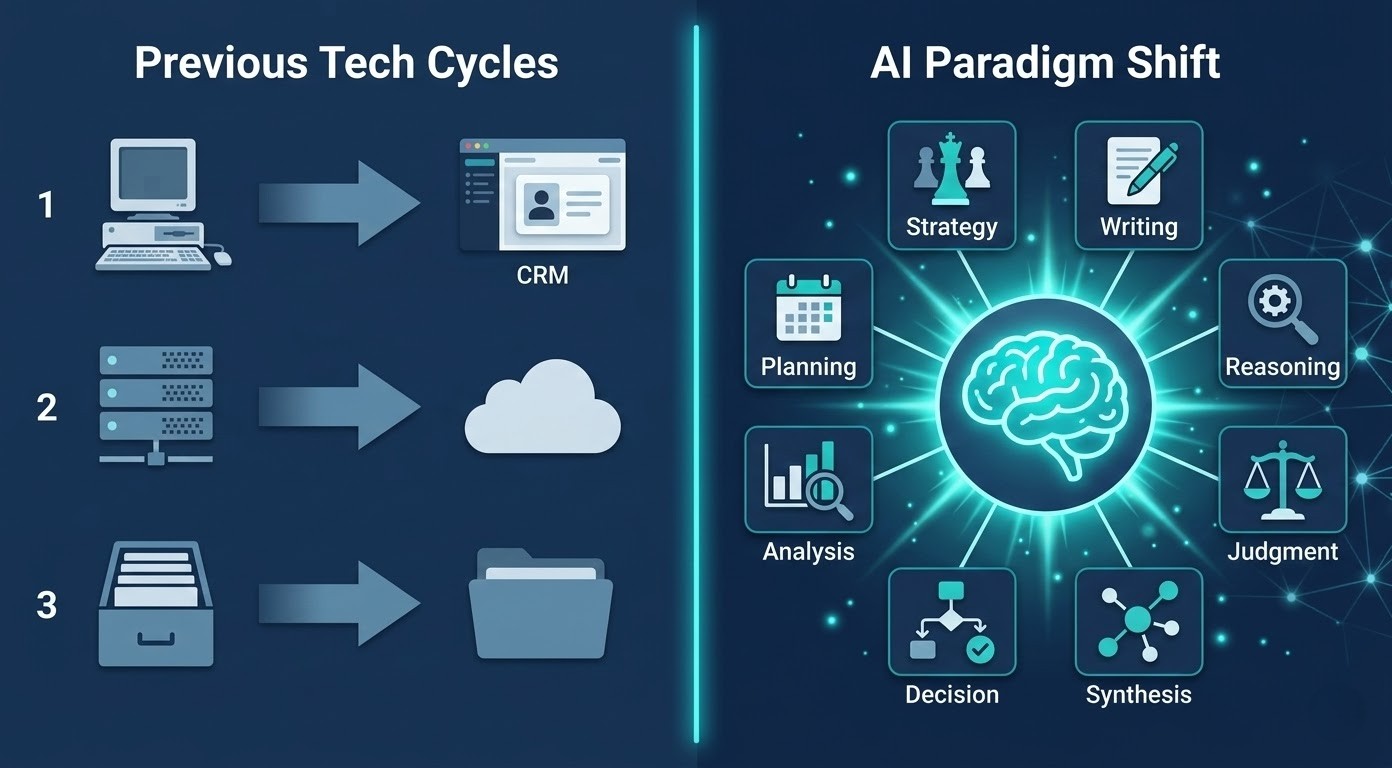
Most organisations have approached AI as they would any other technology upgrade – adopt the tool, train the team on the interface, move on. That approach worked for CRM systems. It worked for cloud migration. It will not work for AI.

AI is not behaving like previous technology cycles. Previous tools automated specific, defined tasks. AI is automating the cognitive layer – the reasoning, the synthesis, the judgment calls that used to require a human by definition. This is not an incremental improvement. It is a structural shift in how organisations create value.

With the National AI Action Plan 2026–2030 now in motion, the Malaysian government has signalled clearly that this shift is not optional. The infrastructure, the policy framework, and the economic incentives are all aligned in one direction. Organisations that move deliberately will be positioned to lead. Organisations that wait will find the gap increasingly expensive to close.

The organisations pulling ahead are not doing it with larger budgets. They are doing it with better decisions – specifically, the decision to build AI literacy at the team level before it becomes a crisis at the board level.

3. From AI Tools to AI Agents: Understanding the Real Shift

To understand where this is heading, it is important to distinguish between two fundamentally different categories of AI capability that are often conflated in the same conversation.

What Is an AI Tool?

You already use AI tools. ChatGPT, Microsoft Copilot, Google Gemini. The pattern is consistent across all of them: you provide an input, the AI generates an output, you evaluate it and decide what to do next. The human is always in the loop – directing, deciding, executing at every step.

AI tools are genuinely valuable. They accelerate individual productivity, reduce drafting time, and surface information faster than traditional search. But they have a structural limitation: they require constant human operation. Remove the human and the work stops.

What Is an AI Agent?

An AI agent is fundamentally different in one way that changes everything about how organisations should think about workforce capability:

It pursues an objective. Not just a prompt.
You tell an AI tool: “Write me a summary of this vendor proposal.” It writes the summary. It stops. It waits for your next instruction. You give an AI agent an objective: “Evaluate all three vendor proposals, compare them against our procurement criteria, flag any compliance gaps, and prepare a recommendation for the committee by Friday.” The agent does not wait. It works. It reasons through the task sequentially, accesses the information it needs, checks its own output against the objective, course-corrects where necessary, and delivers – autonomously.

This is not a marginal improvement in productivity. It is a different category of organisational capability entirely.

Aspect AI Tools AI Agents
Interaction model Prompt → Output → Wait Objective → Autonomous execution
Human involvement Required at every step Oversight and supervision
Task scope Single-step tasks Multi-step workflows
Decision-making Human decides next action Agent reasons and course-corrects
Examples ChatGPT, Copilot, Gemini Claude Code, n8n, MCP-enabled systems
Organisational impact Individual productivity gains Structural capability shift

This Is Already Operational

It is important to be clear on this point: agentic AI is not an emerging technology on a roadmap. It is already running inside forward-thinking organisations.

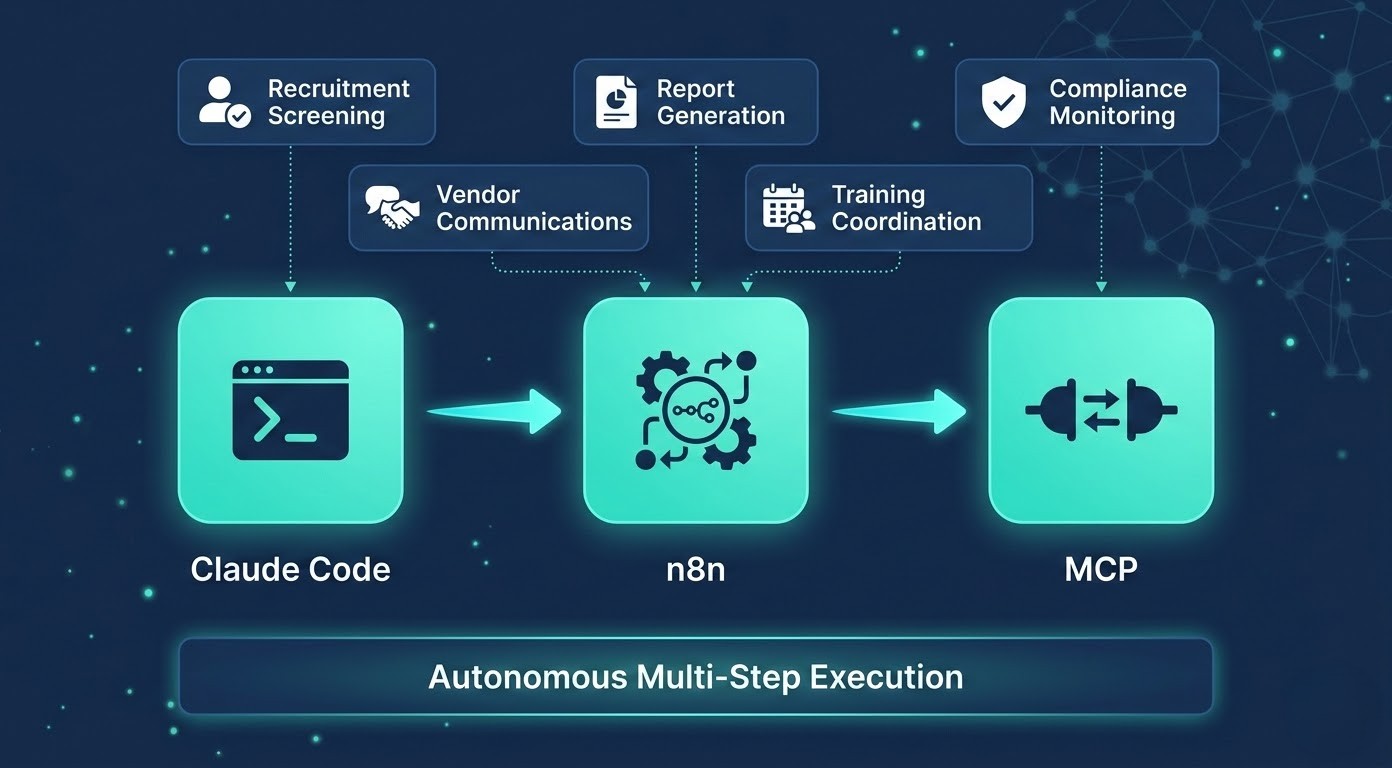
Tools like Claude Code, n8n, and MCP-enabled systems are handling multi-step workflows today that previously required dedicated team members to manage from start to finish. Recruitment screening, report generation, vendor communications, training coordination, compliance monitoring – these workflows are being handled autonomously by AI agents in organisations that made the decision to build this capability intentionally.

The question is not whether agentic AI will arrive in your industry. It is whether your organisation will be ready when it does.

4. Why This Is a Workforce Development Problem

Here is where the conversation becomes critical for HR and L&D leaders specifically.

When an organisation moves from AI tools to AI agents, the training requirement changes fundamentally. You are not teaching your team to use a new application. You are developing an entirely new organisational capability:

Define objectives clearly
AI agents pursue objectives. If the objective is poorly defined, the output will reflect that. The ability to articulate clear, measurable, well-scoped objectives is a human skill that becomes exponentially more valuable in an agentic AI environment.
Supervise autonomous systems intelligently
An AI agent working autonomously still requires human oversight. Someone needs to understand what the agent is doing, evaluate whether it is doing it correctly, and intervene when the situation exceeds the agent’s judgment. This requires a level of AI literacy that goes significantly beyond knowing how to write a prompt.
Make judgment calls that AI cannot make
AI agents are exceptional at executing defined processes. They are not equipped to navigate ambiguity, manage stakeholder relationships, or make ethical judgment calls in novel situations. The human role in an agentic organisation is not eliminated – it is elevated. But it requires a different skill set than most organisations are currently building.

This is not a technology training problem. It is a workforce development problem. And it sits squarely within the mandate of every HR and L&D leader reading this.

5. The Uncomfortable Question for Malaysian Organisations
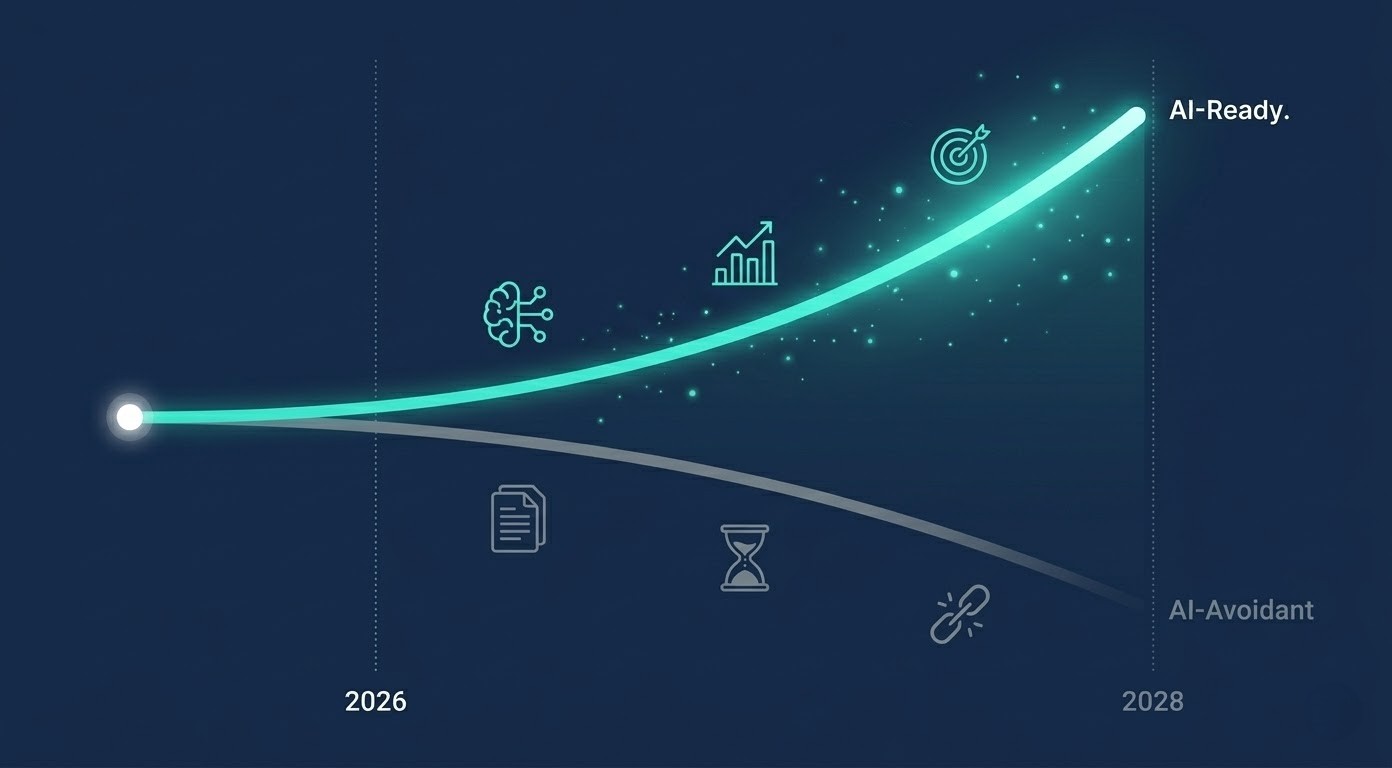
Most Malaysian organisations are preparing for the tool era while the agent era is already arriving.

Generic AI literacy workshops are valuable. Knowing how to use ChatGPT effectively is a legitimate skill. But it is not sufficient preparation for an environment where AI agents are autonomously executing multi-step workflows inside your organisation and your competitors’ organisations simultaneously.

When agentic AI arrives inside your industry – and it is already arriving – will your people know how to work alongside it, or will they be replaced by organisations whose people do?

Because in twelve months, the answer will be visible. In your retention numbers. In your operational margins. In whether your organisation shows up when a potential client asks an AI engine who the best provider in your space is.

The window to lead is still open. But it is not permanent.

6. What AI-Ready Organisations Are Doing Differently

Organisations that are building genuine agentic AI readiness share several characteristics that distinguish them from organisations still treating AI as a tool adoption problem.

They are investing in structured AI literacy programmes – not one-off workshops, but sustained capability building that develops the skills required to work alongside autonomous systems over time.

They are building clear AI governance frameworks – defining how AI agents are deployed, supervised, and evaluated within the organisation before the technology is implemented, not after.

They are leveraging available funding mechanisms – in Malaysia, HRD Corp claimable programmes provide a direct path to funding structured AI Readiness training without it representing a net cost to the organisation.

They are treating AI readiness as a strategic priority at the board level – not delegating it entirely to IT or leaving it to individual team members to figure out independently.

Most importantly, they are moving before the urgency becomes a crisis. The organisations building AI-ready workforces in 2026 will set the operational benchmark that everyone else attempts to match in 2028.

7. Where Does Your Organisation Stand?

The National AI Action Plan 2026–2030 is not just a government document. It is a signal that the infrastructure, the policy framework, and the economic expectation are all moving in one direction.

The AI Divide is real. The gap between AI-ready and AI-avoidant organisations is already measurable and it is widening. The question for every HR and L&D leader is not whether to respond – it is whether to respond deliberately or reactively.

Deliberate responses build capability ahead of need. Reactive responses are always more expensive and less effective.

Build Agentic AI Readiness for Your Team

Ommtech’s HRD Corp claimable programmes are aligned with Malaysia’s national AI readiness priorities – structured to develop the specific capabilities your team needs to work alongside AI agents.

View HRD Corp Claimable Courses

Frequently Asked Questions

What is the AI Divide?

The AI Divide refers to the widening gap between organisations that have built genuine AI readiness – including the ability to work alongside autonomous AI agents – and those still relying on pre-AI workflows. It is already measurable in operational efficiency, talent retention, and market visibility.

What is the difference between an AI tool and an AI agent?

An AI tool responds to individual prompts and requires human direction at every step. An AI agent pursues an objective autonomously – reasoning through multi-step tasks, accessing information, course-correcting, and delivering results without constant human input.

What is agentic AI?

Agentic AI refers to AI systems that can autonomously plan, reason, and execute multi-step workflows toward a defined objective. Unlike conversational AI tools, agentic AI systems can work independently, make decisions, and complete complex tasks without requiring a human prompt at every step.

Is agentic AI relevant to Malaysian businesses now?

Yes. Tools like Claude Code, n8n, and MCP-enabled systems are already being used by forward-thinking organisations globally and in the region. The National AI Action Plan 2026–2030 has also signalled that AI adoption is a strategic priority for Malaysia, with supporting infrastructure and incentives already in motion.

Is AI training claimable under HRD Corp?

Yes. Ommtech is an HRD Corp approved training provider. Our AI Readiness and Agentic AI programmes are HRD Corp claimable, meaning registered employers can recover the training investment through the HRD Corp levy system.

What is the National AI Action Plan 2026–2030?

The National AI Action Plan 2026–2030 is a Malaysian government initiative setting the strategic direction for AI adoption across the economy. It includes infrastructure development, policy frameworks, and economic incentives designed to accelerate responsible AI adoption among Malaysian organisations.
Claude Skills vs Plugins: What Malaysian Businesses Need to Know About AI Extensibility in 2026

February 28, 2026

The way we extend and customise AI assistants is changing fast. If you’ve been following the AI space – or if you’re considering AI training for your organisation – you’ve likely heard terms like “plugins,” “skills,” “MCP,” and “custom GPTs” thrown around.

But what do they actually mean? And more importantly, which approach delivers real results for your business?

This guide breaks down the key differences between Claude Skills and the plugin model, explains why it matters for organisations adopting AI, and helps you understand what to look for in HRD Corp claimable AI training programmes that teach practical, current knowledge.

The Rise and Fall of AI Plugins

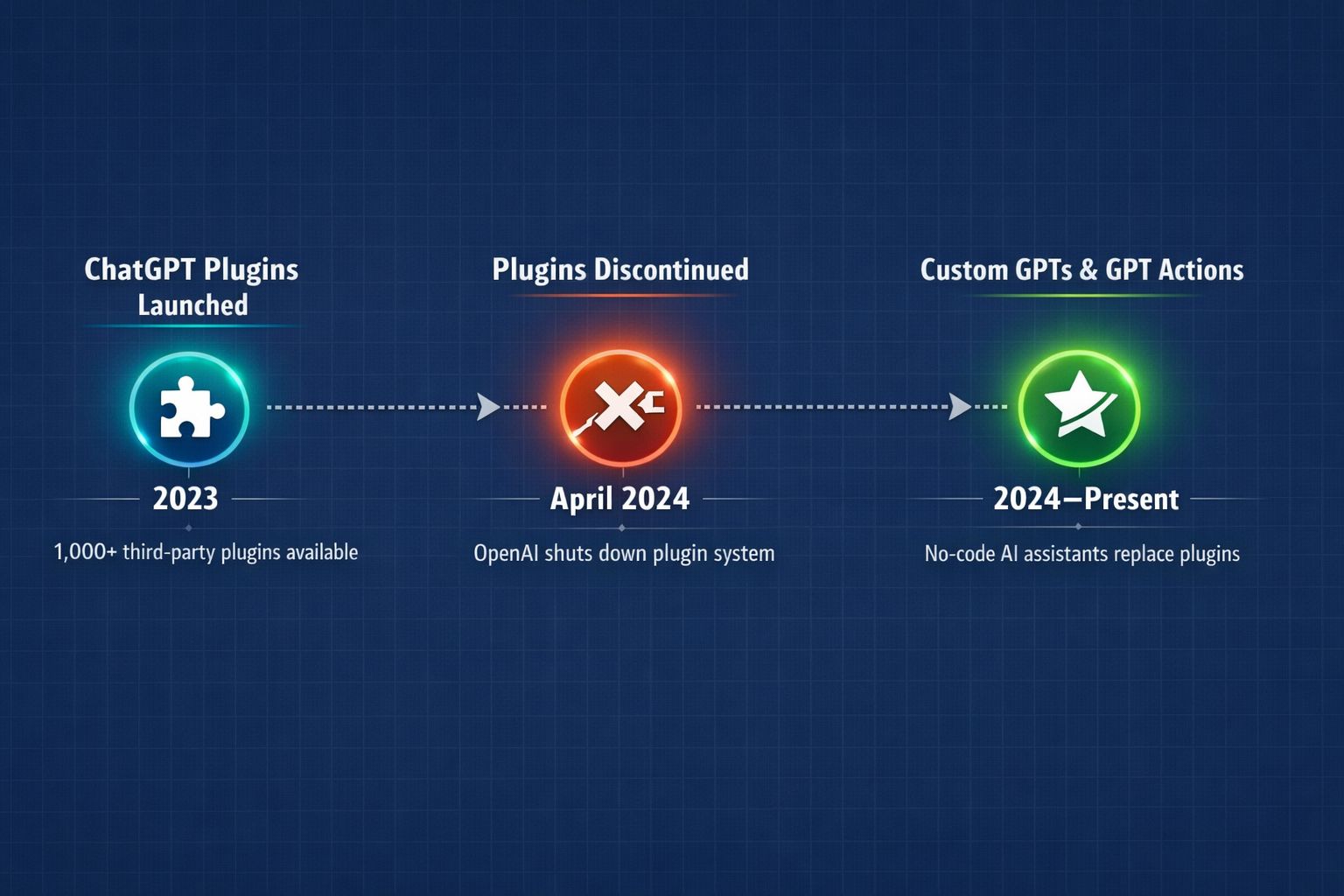
ChatGPT Plugins were one of the first major attempts to let an AI assistant connect with external tools and services. Launched by OpenAI in 2023, plugins allowed ChatGPT to browse the web, analyse PDFs, query databases, and interact with third-party apps like Zapier, Expedia, and Wolfram Alpha.

It sounded revolutionary. In practice, the plugin model had serious limitations.

Plugins required third-party developers to build and maintain each integration. Users had to manually select which plugins to activate for each conversation. Quality varied wildly across the plugin marketplace, and most ChatGPT users never explored the feature. Despite having over 1,000 plugins available, usage remained concentrated among power users. The complexity created friction rather than solving problems.

By April 2024, OpenAI officially discontinued the plugin system entirely. They replaced it with Custom GPTs and GPT Actions – a more flexible approach where anyone could create a specialised AI assistant without coding, and connect it to external services through API actions.

The plugin era lasted barely a year. But the lessons it taught the industry were invaluable.

Enter Claude Skills: A Fundamentally Different Approach

When Anthropic introduced Claude Skills in October 2025, they took a completely different path from the plugin model.

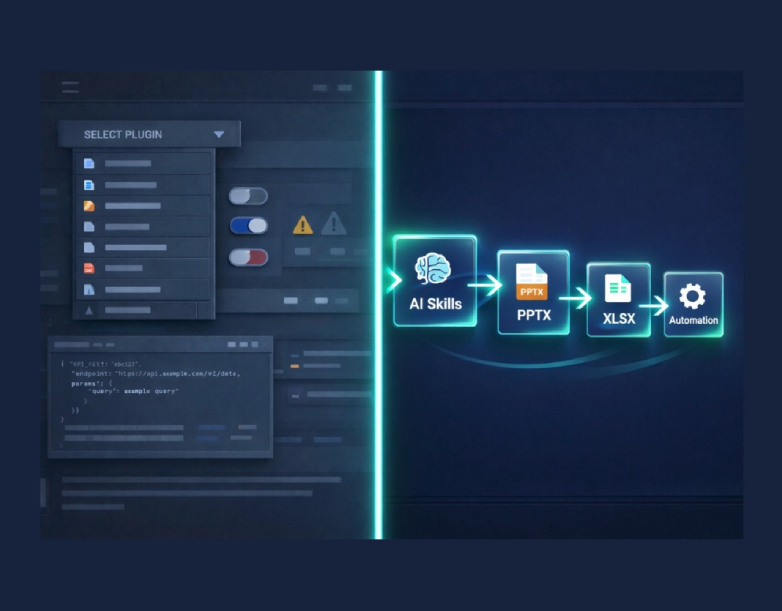
Rather than requiring developers to build external integrations, Skills are folders containing instructions, scripts, and resources that Claude can load on demand. Think of them as knowledge packages – they teach Claude how to perform specific tasks in a repeatable, consistent way.

Here’s what makes Skills different:

Progressive disclosure architecture
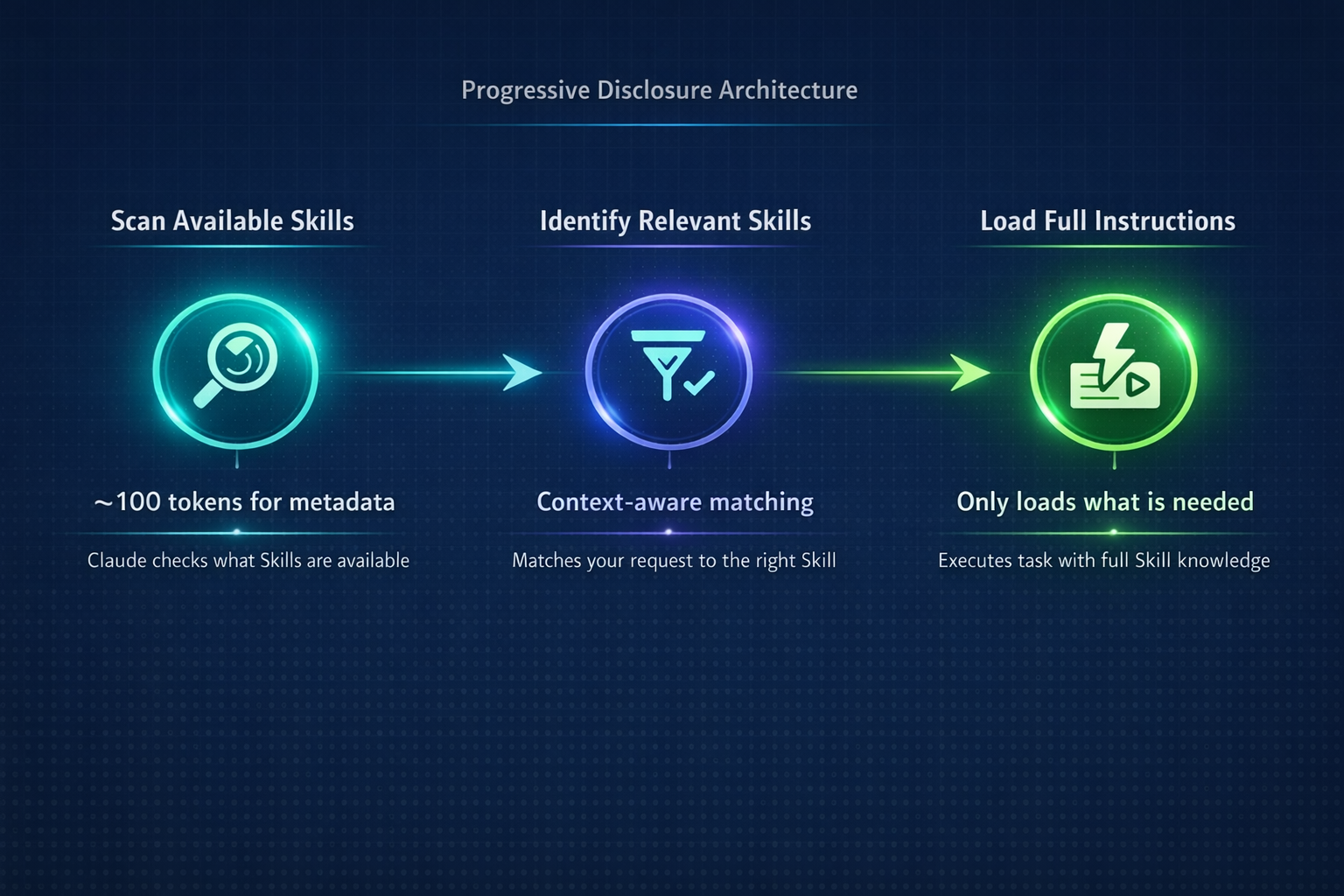
Claude doesn’t load everything at once. It scans available Skills (costing roughly 100 tokens for metadata), identifies which ones are relevant to your task, and only then loads the full instructions. You can have dozens of Skills available without overwhelming the system.
Markdown-based simplicity
Skills are built on Markdown files with optional scripts – not complex API schemas or external servers. A subject matter expert can create a useful Skill without being a software developer. This dramatically lowers the barrier to entry for organisations wanting to customise AI for their workflows.
Automatic invocation
Unlike plugins that required manual selection, Claude automatically identifies and loads relevant Skills based on your request. Ask it to create a PowerPoint presentation and it invokes the PPTX skill on its own. Ask it to generate an Excel report and the XLSX skill activates. No toggling, no configuration.
Code execution in a sandbox
Skills can execute code in a secure environment, enabling deterministic actions like file creation, data parsing, and analytics – not just text generation.
Composability
Multiple Skills can work together in the same task. Unlike plugins where you typically ran one at a time, Skills are designed to stack and complement each other – creating compounding capability over time.

Skills vs Plugins: A Direct Comparison

Aspect ChatGPT Plugins (Discontinued) Claude Skills
Status Discontinued April 2024 Active and expanding
Who builds them Third-party developers required Anyone – Markdown-based
Activation Manual selection per conversation Automatic, context-aware
Technical complexity High – API schemas, server hosting Low – Markdown + optional scripts
Ecosystem Closed, vendor-controlled marketplace Open, shareable, forkable
Code execution Limited to Code Interpreter Full sandbox environment
Composability One plugin at a time (typically) Multiple Skills work together
Transparency Black box Open – read, modify, and share

Where MCP Fits In

You might also hear about MCP – the Model Context Protocol – which Anthropic introduced in November 2024 and later donated to the Linux Foundation. MCP is different from both plugins and Skills, and understanding the distinction matters for how you think about AI investment.

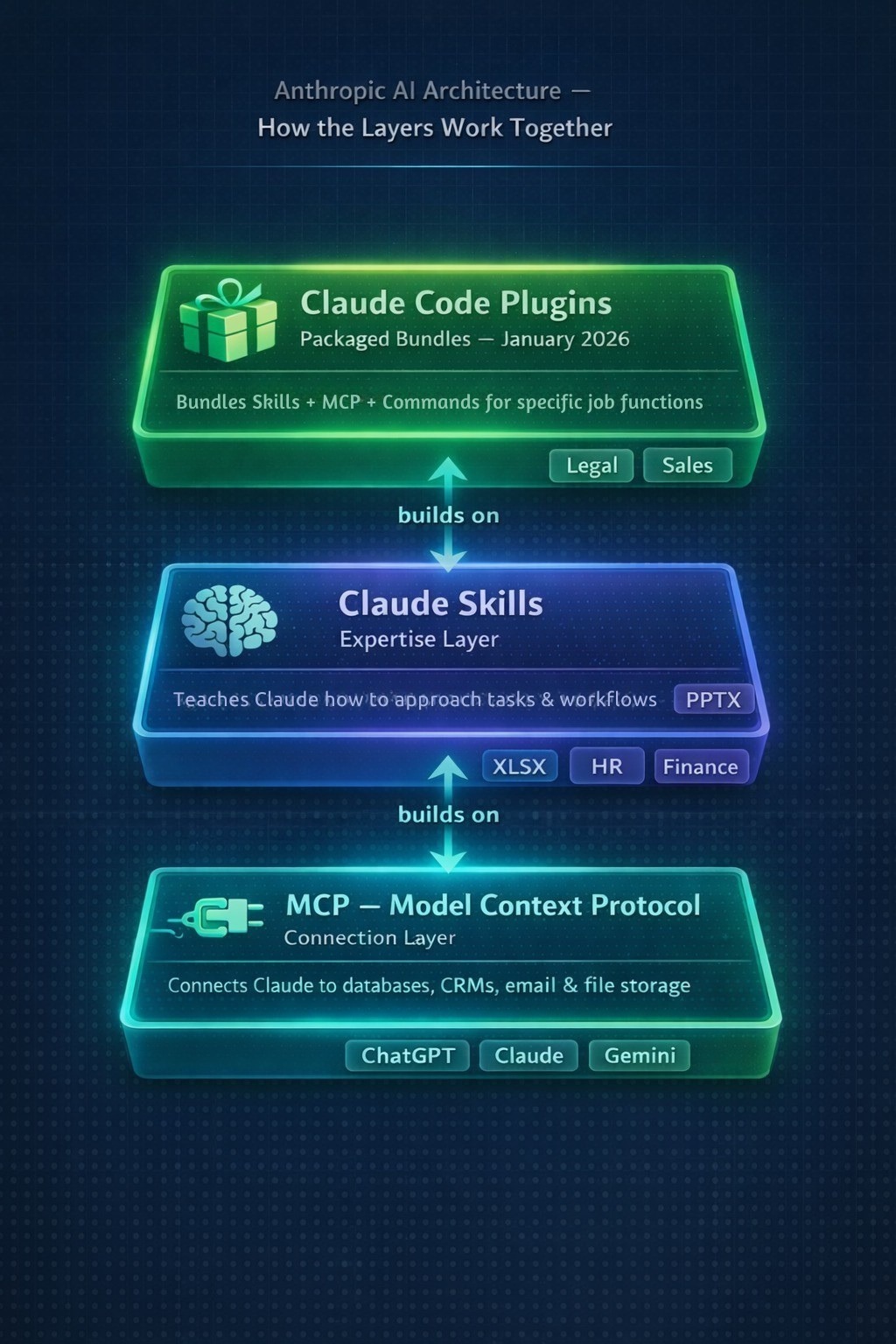
MCP is the plumbing. It provides a standardised way for AI models to connect with external systems – databases, CRMs, email, file storage, and so on. Think of it as a universal connector that now works across Claude, ChatGPT, Gemini, and other major AI platforms. OpenAI adopted MCP in March 2025, followed by Google DeepMind in April 2025, making it the industry standard for AI-to-system connections.

Skills are the expertise. They teach the AI how to approach specific tasks, what best practices to follow, and what workflows to use.

In Anthropic’s evolving architecture, these layers work together. MCP connects Claude to your systems. Skills give Claude the knowledge to work effectively with those systems. And the newest addition – Claude Code Plugins (introduced January 2026) – bundles Skills, MCP connectors, and commands into installable packages for specific job functions like legal review, sales prospecting, and financial reporting.

Why This Matters for Malaysian Businesses

If your organisation is evaluating AI training programmes – especially HRD Corp claimable ones – the Skills vs Plugin distinction isn’t just academic. It directly affects what your team can actually do after the training.

  • Training that teaches the old plugin model is already outdated. Plugins were discontinued nearly two years ago. Any programme still centred on “how to use ChatGPT plugins” is teaching tools that no longer exist.
  • Skills represent the current and future state of AI customisation. Understanding how to create and use Skills means your team can build reusable AI workflows tailored to your specific business processes – from HR onboarding automation to financial reporting to marketing content creation.
  • The barrier to entry has dropped dramatically. With Skills, you don’t need a team of developers to customise AI for your organisation. A well-trained HR manager, marketing executive, or operations lead can create Skills that standardise how AI handles their department’s tasks.
  • Composability changes the game. Because multiple Skills work together, your organisation can build a library of AI capabilities over time. Each new Skill adds to what your team can accomplish, creating compounding returns on your training investment.
  • For Malaysian businesses specifically: The combination of lower entry costs and HRD Corp grant support means that now is an unusually good time to invest in building real AI capability – before competitors do.

What to Look for in HRD Corp Claimable AI Training Programmes

When evaluating AI training for your organisation, here are the questions worth asking before you commit:

  • Does the programme teach current tools? The AI landscape moves fast. Programmes should cover Skills, MCP, and the latest AI capabilities – not discontinued features like plugins.
  • Is there hands-on practice? Understanding AI extensibility concepts is important, but your team needs to actually build something during the training. Creating a Skill, setting up an automation workflow, and seeing real output is what creates lasting capability.
  • Does it cover practical business applications? The best programmes connect AI capabilities directly to business outcomes – automating reporting, streamlining HR processes, accelerating content creation, improving customer communication.
  • Is the trainer actively practising what they teach? AI tools evolve monthly. Trainers who are actively building with these tools daily will teach current, practical knowledge rather than theoretical concepts from six months ago.
  • Can the training be customised to your industry? Generic AI training has limited ROI. Programmes tailored to your specific industry and business challenges deliver far more value.
  • Is the provider HRD Corp approved? Verify the provider’s approval status directly on the HRD Corp portal. Approved programmes allow your organisation to claim training costs under the SBL Scheme.

The Bottom Line

The evolution from plugins to Skills reflects a broader shift in how we think about AI customisation. We’ve moved from a model where extending AI required developers, external servers, and marketplace gatekeepers – to one where domain experts can package their knowledge into reusable, shareable, automatically-invoked capabilities.

For Malaysian businesses navigating the AI transformation, this shift is an opportunity. The organisations that invest in understanding and building with current AI capabilities – not yesterday’s discontinued features – will gain meaningful competitive advantage.

The question isn’t whether your team needs AI skills. It’s whether the training you invest in teaches the right ones.

Ready to Train Your Team on Current AI Tools?

Ommtech Digital Marketing Academy offers HRD Corp claimable AI training programmes covering Claude Skills, MCP, n8n automation, and practical AI implementation – tailored for Malaysian businesses.

View HRD Corp Claimable Courses

Frequently Asked Questions

What are Claude Skills?

Claude Skills are reusable knowledge packages introduced by Anthropic in October 2025. They are folders containing instructions, scripts, and resources that Claude AI can load on demand to perform specific tasks. Unlike ChatGPT Plugins, Skills are markdown-based, automatically invoked, and can be created by anyone without developer expertise.

Are ChatGPT Plugins still available?

No. OpenAI officially discontinued ChatGPT Plugins on April 9, 2024. They were replaced by Custom GPTs and GPT Actions, which are available through the GPT Store. Custom GPTs offer more flexibility and can replicate all plugin functionality.

What is the difference between Claude Skills and ChatGPT Plugins?

The key differences are: Skills are markdown-based and can be created by non-developers, while plugins required third-party developer expertise. Skills are automatically invoked based on context, while plugins required manual selection. Skills are composable – multiple Skills work together seamlessly. And Skills are open and transparent – you can read, modify, and share them. ChatGPT Plugins have been discontinued since April 2024.

What is MCP and how does it relate to Claude Skills?

MCP (Model Context Protocol) is an open standard for connecting AI models to external systems like databases, CRMs, and email. MCP is the plumbing for external connections, while Skills provide domain expertise and workflow knowledge. They complement each other – MCP connects Claude to your systems, and Skills guide Claude in using those systems effectively.

Is there HRD Corp claimable AI training that covers Claude Skills in Malaysia?

Yes. HRD Corp approved training providers like Ommtech Digital Marketing Academy offer AI training programmes covering current tools including Claude Skills, MCP, AI automation, and practical AI implementation strategies tailored for Malaysian businesses. Look for programmes that teach current tools rather than discontinued features like ChatGPT Plugins.

Why should Malaysian businesses care about Claude Skills vs Plugins?

The shift from plugins to Skills reflects how AI customisation has become accessible to non-developers. Malaysian businesses investing in AI training should ensure their programmes teach current capabilities. Skills allow HR managers, marketing executives, and operations leads to create reusable AI workflows without developer support – meaning faster AI adoption and better ROI on training investment.

Can small Malaysian businesses benefit from Claude Skills?

Yes. Because Skills are markdown-based and require no developer expertise, even small businesses with limited IT resources can build custom AI workflows. A single well-trained staff member can create Skills that standardise how AI handles tasks like customer communication, report generation, or content creation.