If your company contributes to the HRD Corp levy, you’re sitting on a dedicated training budget – one that stays in your account indefinitely but represents idle capital if left unused. That makes choosing the right digital marketing course a genuinely strategic decision, not just a box-ticking exercise.
But the digital marketing training landscape in Malaysia has changed dramatically. AI tools have reshaped how campaigns are planned, executed, and measured. Social media platforms have introduced new advertising formats, algorithm changes, and commerce features. The skills that made a marketing team effective in 2023 may not be the skills they need in 2026.
This guide helps HR managers, L&D leads, and business owners evaluate what’s actually worth investing in – and what to watch out for when choosing a provider.
1. How HRD Corp Training Claims Actually Work
Before evaluating any course, it’s worth understanding the mechanics of the system you’re working with. HRD Corp (formerly HRDF) allows levy-contributing employers to claim back training costs through the SBL-Khas scheme, where HRD Corp pays the training provider directly from your company’s levy balance.
The process is straightforward but has firm requirements:
- Grant application before training – You must submit through the e-TRiS portal at least one day before the course begins. Retroactive claims are not accepted.
- Registered providers only – The training provider must be HRD Corp-registered, and the specific course must have a valid HRD Corp Claimable Course Code (previously called Siri Kursus). You can verify this code directly in the HRD Corp grant search portal before engaging any provider.
- Supporting documents required – Course fee quotation, trainer profile (must be TTT-certified or HRD Corp-accredited), course content outline, and training schedule.
- Optional upfront deposit – Training providers may request up to 30% of the course fee as an upfront deposit with the employer’s consent. This is optional, not mandatory.
- Post-training compliance – Attendance records, completion documentation, and JD14 forms must be finalised after training. The JD14 must be signed by a Manager or higher-level authority. While the system allows up to six months for claim submission, official guidelines strongly recommend completing all documentation within 30 days of training to avoid processing delays.
Grant approvals under SBL-Khas are typically fast – 3–5 working days when documentation is complete, significantly quicker than the conventional SBL scheme which can take 7–14 days. A 4% service fee is deducted by HRD Corp from the training provider’s claim, not from the employer’s levy balance – meaning the employer gets the full value of the training without absorbing any administrative cost.
2. The 7 Categories of Digital Marketing Training Available
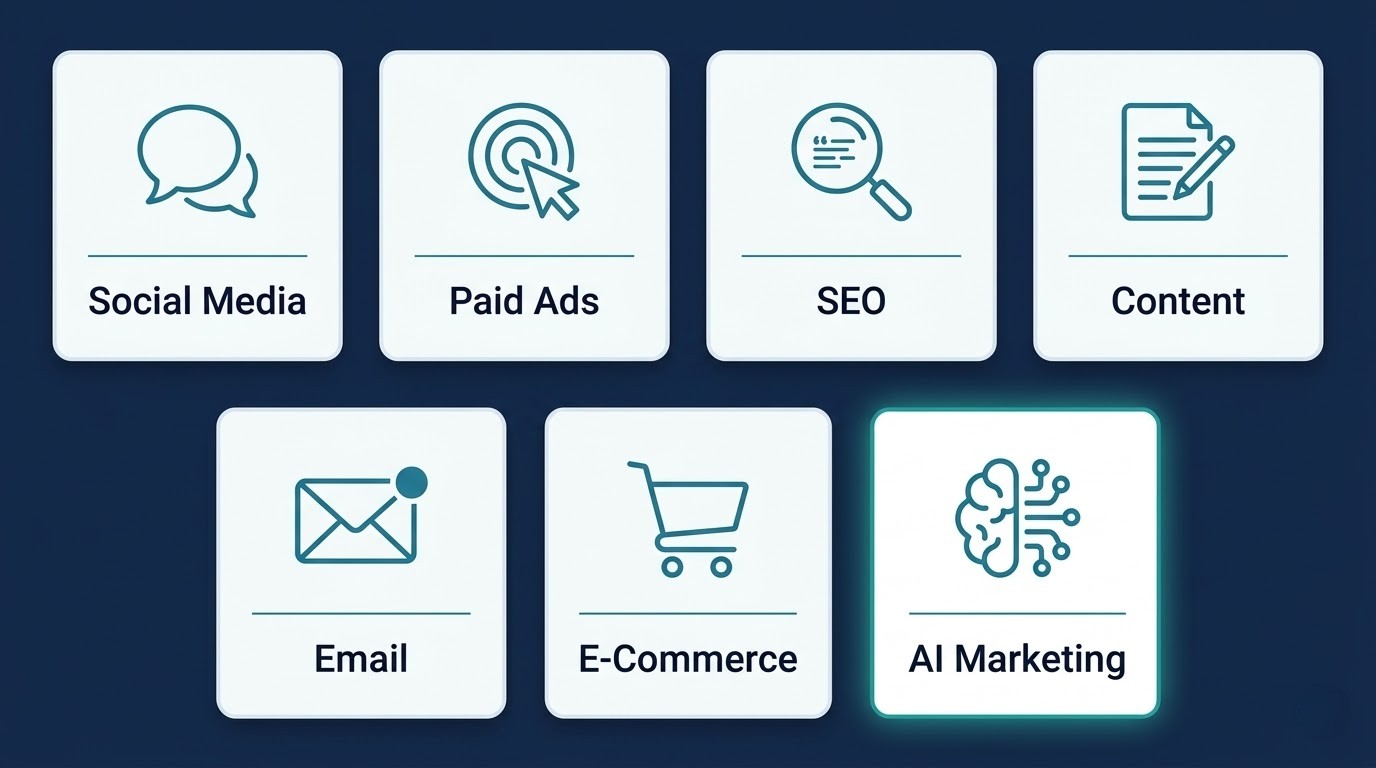
Not all digital marketing courses teach the same thing, and the labels used by training providers can be misleading. Here are the seven distinct categories you’ll encounter in the Malaysian market:
Social Media Marketing
Covers platform-specific strategy, content planning, community management, and organic growth across Facebook, Instagram, TikTok, LinkedIn, and other platforms. The best courses in this category now include AI-powered content creation tools and social search optimisation.
Paid Advertising (Social & Search)
Focuses on Facebook Ads, Instagram Ads, Google Ads, TikTok Ads, and campaign management. Includes audience targeting, bidding strategies, creative testing, and performance analysis. More advanced courses cover AI-driven ad optimisation and automated bidding.
Search Engine Optimisation (SEO)
Covers on-page and off-page SEO, technical SEO, keyword research, and content optimisation for Google. In 2026, this category increasingly overlaps with Answer Engine Optimisation (AEO) – optimising content so it appears in AI-generated search results from tools like ChatGPT, Perplexity, and Google AI Overviews.
Content Marketing & Strategy
Teaches content planning, editorial calendars, blog strategy, video content frameworks, and content distribution. The distinction between this and social media marketing is strategic depth – content marketing focuses on the broader system, not just individual posts.
Email Marketing & Automation
Covers email list building, campaign design, segmentation, A/B testing, and marketing automation workflows. Increasingly includes AI-powered personalisation and predictive send-time optimisation.
E-Commerce & Social Commerce
Focuses on selling through digital platforms – Shopee, Lazada, TikTok Shop, Instagram Checkout, and direct-to-consumer websites. Covers product listing optimisation, fulfilment workflows, and platform-specific advertising.
AI-Powered Digital Marketing
A newer category that specifically addresses using AI tools in marketing workflows – generative AI for content creation, AI analytics for campaign optimisation, chatbots for customer engagement, and AI-driven personalisation. This is the fastest-growing training category in Malaysia’s market.
3. Why AI Has Changed What “Digital Marketing Training” Means
This is the most important consideration for anyone evaluating digital marketing training in 2026, and it’s where most buyer’s guides fail – they treat digital marketing as a stable category. It isn’t.
AI has fundamentally changed the daily workflow of marketing teams. Content that used to take a copywriter a full day can now be drafted in minutes. Campaign performance analysis that required a dedicated analyst can now be surfaced by AI tools in real time. Social media scheduling, A/B testing, audience segmentation, and even creative production have all been accelerated or partially automated.
This doesn’t mean every course needs to be about AI. A social media marketing course should still teach platform strategy, audience psychology, and content planning. But if the course teaches Facebook content creation without showing how AI tools like ChatGPT, Canva AI, or Meta’s own AI features fit into the workflow, it’s leaving a critical gap.
The practical question for L&D managers is this: will your team return from the training able to work with the tools they’ll actually use on Monday morning?
The most valuable digital marketing training in 2026 doesn’t just teach platforms and tactics. It teaches your team how to use AI to execute faster, analyse deeper, and adapt in real time – skills that compound across every channel.
4. Course Category Comparison: What Each Covers and Who It’s For
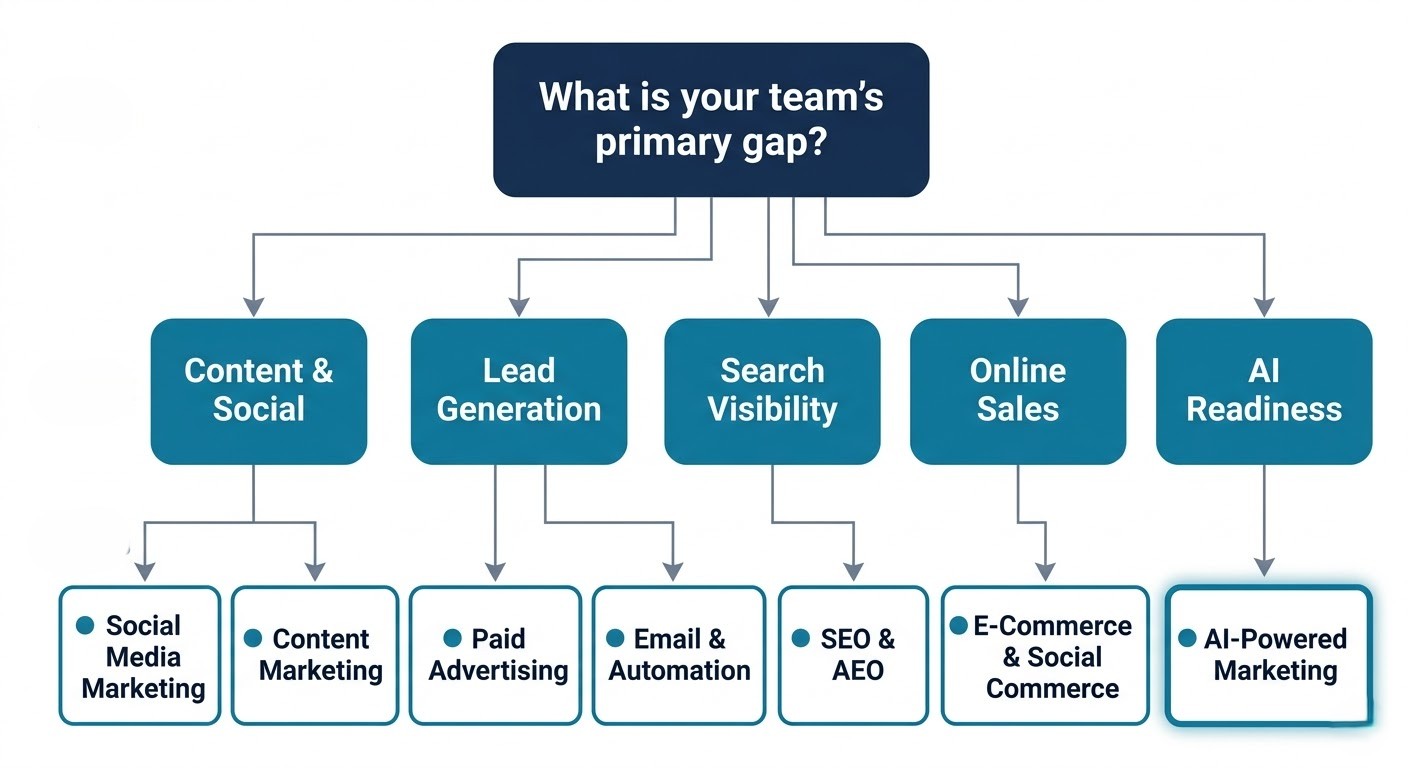
This comparison helps you match the right category to your team’s actual needs, rather than defaulting to a generic “digital marketing” course that tries to cover everything.
| Category | Best For | Duration | AI Integration? | Typical Fee Range |
|---|---|---|---|---|
| Social Media Marketing | Marketing execs, brand managers, social media teams | 1–2 days | Should include AI content tools | RM 1,800 – RM 3,000 |
| Paid Advertising | Performance marketers, ad buyers, campaign managers | 2–3 days | Should include AI bidding & targeting | RM 1,800 – RM 3,000 |
| SEO | Content teams, webmasters, digital strategists | 1–2 days | Must include AEO & AI search | RM 1,800 – RM 3,000 |
| Content Marketing | Marketing managers, copywriters, brand strategists | 1–2 days | Should include generative AI workflows | RM 1,800 – RM 3,000 |
| Email & Automation | CRM teams, email marketers, sales ops | 1–2 days | Should include AI personalisation | RM 1,800 – RM 3,000 |
| E-Commerce | E-commerce managers, retail teams, D2C brands | 1–3 days | Should include AI product listing tools | RM 1,800 – RM 3,000 |
| AI-Powered Marketing | All marketing roles, L&D managers, business owners | 1–2 days | 100% AI-focused | RM 1,800 – RM 3,000 |
Note: Fee ranges are indicative based on publicly listed prices from Malaysian training providers in early 2026. Actual fees vary by provider, format (in-house vs public), and course depth.
5. How to Evaluate a Digital Marketing Training Provider
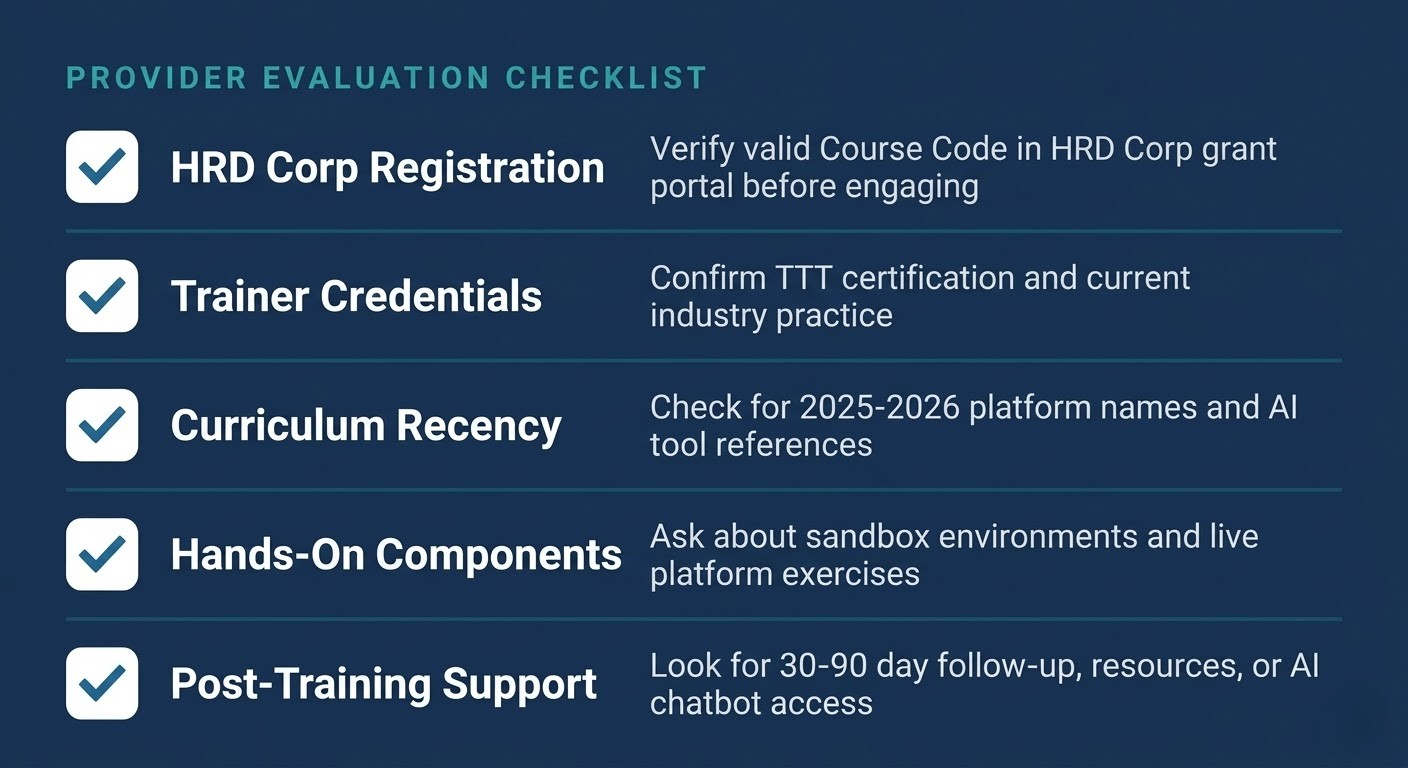
Malaysia has hundreds of HRD Corp-registered training providers offering digital marketing courses. The quality varies enormously. Here’s a practical framework for evaluation:
Check HRD Corp Registration Status
This is non-negotiable. The provider must be registered with HRD Corp, and the specific course you’re considering must have a valid HRD Corp Claimable Course Code (previously referred to as Siri Kursus). You can verify this code directly in the HRD Corp grant search portal before speaking to any sales representative – this prevents providers from claiming a course is claimable when the registration has actually expired.
Review Trainer Credentials
The trainer matters more than the brand. First, confirm they hold a TTT (Train The Trainer) certification or HRD Corp accreditation – without this, the grant application will be rejected regardless of the trainer’s expertise. Beyond that baseline, ask who will be delivering the session, what their professional background is, and whether they are currently practising digital marketing – not just teaching it. A trainer who last ran a real campaign in 2021 is teaching outdated tactics. In 2026, top trainers also hold platform-specific certifications such as Meta Certified Lead Trainer, Google Ads Partner status, or specialised AI credentials.
Examine Curriculum Recency
Request the full course outline. Look for specific tool names and platform features from 2025–2026. Red flags include references to “Facebook Business Suite” (now Meta Business Suite), no mention of Google Ads Performance Max (PMax), or the absence of TikTok Shop Creator Center. On the AI side, a curriculum that doesn’t reference current generative AI models, AI-powered analytics, or prompt engineering techniques is likely running an outdated syllabus.
Ask About Hands-On Components
The most effective training includes practical exercises using live platforms, not just slides and theory. Ask what percentage of the training is hands-on, whether participants work on their own business accounts, and what they’ll leave with (templates, frameworks, campaign drafts). Importantly, ask whether the provider offers sandbox environments or temporary ad account access for practice – many companies are understandably hesitant to let staff experiment on live accounts with real ad spend.
Verify Post-Training Support
Good providers offer some form of follow-up – a Q&A session 30 days after training, a resource library, or a community group. The gold standard in 2026 is providers who offer a custom AI chatbot trained on their specific course materials, giving participants 30–90 days of on-demand guidance as they apply what they’ve learned. This signals confidence in their content and a genuine investment in your team’s outcomes.
6. 5 Red Flags When Choosing a Training Provider
Knowing what to avoid is just as valuable as knowing what to look for. These are the warning signs that suggest a provider won’t deliver real value:
1. “Comprehensive digital marketing” in one day. Any provider claiming to cover SEO, social media, paid ads, content marketing, email marketing, and analytics meaningfully in a single day is skimming surfaces. You’ll get awareness-level exposure at best, with no depth to apply anything.
2. No AI integration in the 2026 curriculum. As discussed above, this is now a fundamental gap. If a course outline for 2026 reads identically to one from 2023, the content hasn’t evolved with the market.
3. Trainer profiles without current practice. Academic certifications and “10 years of training experience” sound impressive, but the question is whether the trainer is currently running campaigns, managing accounts, or using the tools they teach. The digital marketing landscape changes too fast for theory-only trainers.
4. No course outline provided before commitment. If a provider won’t share a detailed session-by-session outline before you apply for the HRD Corp grant, treat this as a transparency issue. You need the outline for your grant application anyway.
5. Over-reliance on platform certifications as differentiators. Google Ads certification or Meta Blueprint badges demonstrate baseline knowledge, but they’re freely available online. A provider’s value should be in practical application, local market context, and AI integration – not in certifications anyone can earn independently.
7. How to Maximise ROI From Your Training Budget
Claiming back the course fee is only the first layer of ROI. The real return comes from how well the training translates into improved performance. Here’s how to structure the investment for maximum impact:
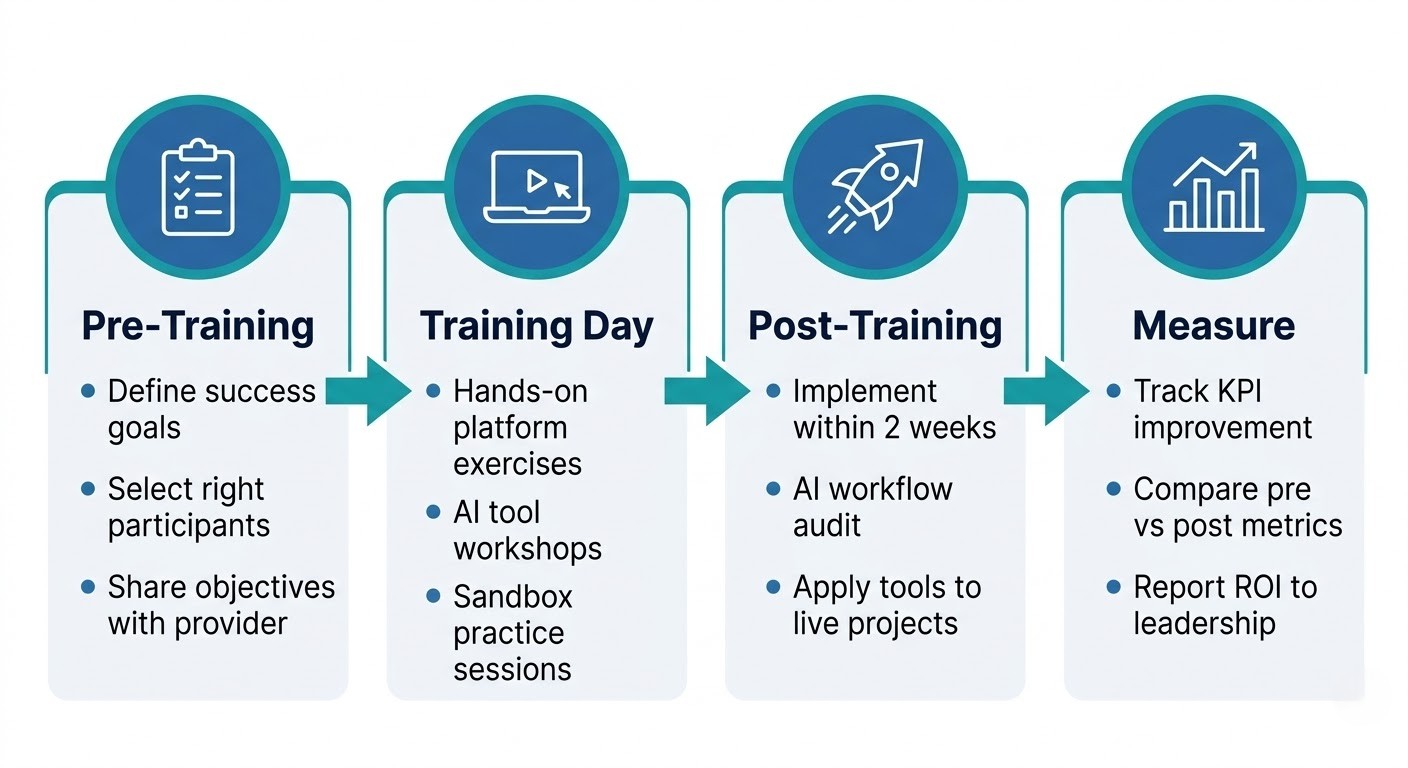
Pre-training alignment. Before sending your team, define what success looks like. Is it faster content production? Better ad performance? Higher engagement rates? Share these goals with the training provider so they can tailor emphasis where it matters for your business.
Send the right people. A common pitfall is sending junior staff to senior-level courses or vice versa. Match course depth to participant capability. A beginner course won’t challenge your experienced marketer, and an advanced course will overwhelm someone without fundamentals.
Require post-training implementation. Within two weeks of completing the course, participants should apply at least one new technique or tool to a live project. This cements learning and gives you an early indicator of whether the training delivered practical value.
Combine categories strategically. Rather than sending your whole team to the same generic course, split them across specialised categories based on their roles. Your content creator attends the AI-powered content workshop. Your ads specialist attends the paid advertising course. Your strategist attends the analytics training. This builds complementary strengths across the team.
Monitor your levy utilisation. Inactivity has real consequences. HRD Corp levy contributions accumulate monthly, but leaving your balance idle carries risks. If your company makes no claims for 24 continuous months, your balance is forfeited – with only RM10,000 maintained in your account. Employers with less than RM10,000 are not affected by this forfeiture. Separately, a one-off 15% deduction under the Program Latihan Madani (PLM) was applied to unused 2023 balances as announced in Budget 2024 – any further PLM deductions are subject to future government announcements. Beyond these penalties, a large unused balance simply represents idle training capital. Map your training calendar to your levy balance so you’re investing consistently rather than letting funds sit dormant while your competitors upskill.
8. What Malaysian Businesses Should Prioritise in 2026
If you had to allocate your HRD Corp digital marketing training budget right now, here’s the priority order based on where the biggest skills gaps and market opportunities exist:
First priority: AI-Powered Digital Marketing. This is the foundational layer that amplifies everything else. A team that understands how to use AI tools for content, analytics, and campaign optimisation will get more value from every other course they take afterwards.
Second priority: Social Media Marketing (with AI integration). Social platforms remain the primary digital touchpoint for Malaysian consumers. Short-form video, social commerce, and community-driven marketing are all growing fast – and AI tools are reshaping how all of them are executed.
Third priority: SEO & Answer Engine Optimisation. Traditional SEO still matters, but the shift toward AI-powered search means your team needs to understand both. Businesses that optimise only for Google but ignore ChatGPT, Perplexity, and Google AI Overviews are leaving visibility on the table.
Fourth priority: Paid Advertising. Platform ad costs continue to rise, making efficient campaign management more important than ever. AI-driven bidding and creative testing are now standard features on major platforms – your team needs to know how to use them. With Malaysia’s stricter PDPA (Act 709) amendments now in force, paid advertising training should also cover first-party data handling and privacy-compliant targeting to avoid regulatory penalties.
Fifth priority: E-Commerce & Social Commerce. If your business sells products online, this is essential. TikTok Shop, Shopee, and Instagram commerce are growing rapidly in Southeast Asia, and each platform has its own optimisation requirements.
The smartest L&D investment in 2026 isn’t picking one course. It’s building a training roadmap that layers AI literacy first, then channels expertise on top – so every ringgit of levy budget compounds into lasting capability.
Build Your Team’s Digital Marketing & AI Capabilities
Ommtech Digital Marketing Academy offers HRD Corp claimable training programmes covering AI-powered digital marketing, social media strategy, and practical business automation – tailored for Malaysian businesses.
Frequently Asked Questions
What types of digital marketing courses are HRD Corp claimable in Malaysia?
Most digital marketing training categories are claimable under HRD Corp’s SBL-Khas scheme, including social media marketing, SEO, paid advertising (Google Ads, Facebook Ads), content marketing, email marketing, e-commerce, and AI-powered digital marketing. The key requirement is that the course must be delivered by an HRD Corp-registered training provider with a valid HRD Corp Claimable Course Code.
How do I claim HRD Corp for a digital marketing training course?
Submit a grant application through the e-TRiS portal at least one day before the training begins. You’ll need the course fee quotation, trainer profile (must be TTT-certified), course outline, and training schedule. Under the SBL-Khas scheme, HRD Corp pays the training provider directly from your company’s levy balance, so there’s no upfront payment required. After training, ensure attendance records and JD14 forms are completed – the JD14 must be signed by a Manager or higher. While the system allows up to six months, it’s strongly recommended to finalise all documentation within 30 days to avoid processing delays.
How much does a HRD Corp claimable digital marketing course cost in Malaysia?
Prices vary by category and provider. Social media and content marketing courses typically range from RM 1,800 – RM 3,000 for 1–2 day programmes. Paid advertising and e-commerce courses tend to be RM 1,800 – RM 3,000 for 2–3 day programmes. AI-powered marketing courses are typically RM 1,800 – RM 3,000. Under SBL-Khas, the full course fee is deducted from your levy balance, effectively making the cost zero out-of-pocket for the employer.
Should I choose a specialised or general digital marketing course?
Specialised courses deliver better ROI for most teams. A 1-day “comprehensive digital marketing” course can only skim surfaces across all channels. Instead, identify your team’s specific skill gaps – social media strategy, paid advertising, SEO, or AI tools – and invest in targeted training that builds depth in those areas. The comparison table in this guide can help you match categories to team roles.
Do digital marketing courses in 2026 need to include AI?
Yes. AI tools have become integral to virtually every digital marketing workflow – from content creation and campaign optimisation to analytics and customer targeting. A course that doesn’t integrate AI tools into its curriculum is teaching workflows that are already partially outdated. When evaluating providers, ask specifically which AI tools are covered and how they’re used in hands-on exercises.
What happens if my company's HRD Corp levy balance is insufficient?
If your levy balance doesn’t fully cover the course fee, you can ask the training provider to invoice HRD Corp for the available levy amount and pay the remaining balance directly to the provider. It’s important to check your levy balance on the e-TRiS portal before applying for any grant. Be aware that if no claims are made for 24 continuous months, your balance is forfeited down to RM10,000.